

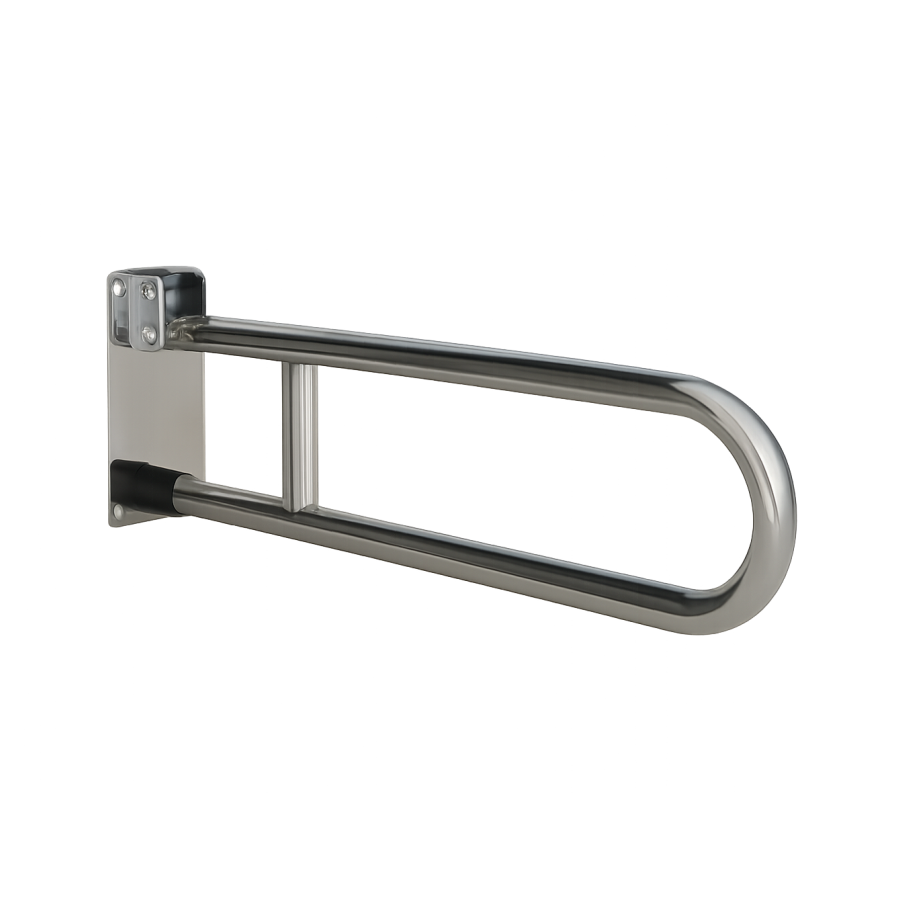
Grab bars next to the toilet: types, heights and correct installation
A well-placed grab bar is the simplest and cheapest way to make the toilet safer. It gives support when sitting down and standing up and helps prevent falls. Here is how to choose and position the right one.
Types of grab bars
- Folding grab bars – fold up against the wall when not needed, so the space beside the toilet stays free, e.g. the FFK606-800 (600 or 800 mm, also free-standing).
- Fixed grab bars with side support – maximum stability, e.g. the KK600-800, left- or right-hand.
- Right-angle grab bars – support both standing up and sitting, e.g. the DK600/300.
- Straight grab bars – for walls beside the toilet, shower or bath, e.g. the EK300-900 in 300–900 mm lengths.
All our grab bars are made of brushed stainless steel with a 32 mm tube for an ergonomic grip.
Reference dimensions (DIN 18040)
The German accessibility standard DIN 18040 is a widely used reference for barrier-free bathrooms. For folding grab bars at the toilet it recommends:
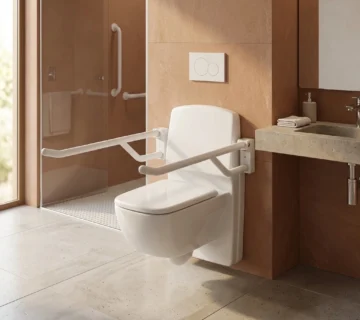
- grab bars on both sides of the toilet
- top edge 28 cm above the seat height
- protruding at least 15 cm beyond the front edge of the toilet
- a clear distance of 65–70 cm between the two grab bars
- a load capacity of 1 kN at the front end of the grab bar
The same guidance gives a toilet seat height of 46–48 cm including the seat. These values are a good starting point; for an individual user, the ideal height may differ – ask an occupational therapist or physiotherapist.
Installation tips
- Fix grab bars only into a load-bearing wall with suitable anchors.
- Check that the user can reach the grab bar from a seated position.
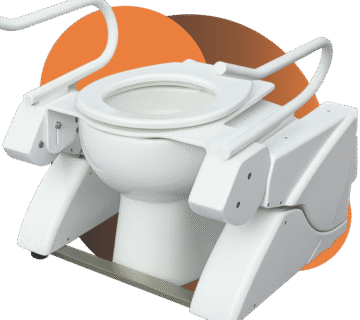
- If the arms are too weak to push up, combine grab bars with a TGH-01 arm lift or an electric toilet lift.
Need help choosing? Ask us for an offer – tell us the wall type and the space beside the toilet.
[…] Grab bars – folding, fixed and right-angle stainless steel grab bars with a 32 mm tube; see our guide to grab bar heights. […]